
Hi Arooj, thank you for joining us! We’re thrilled to discuss your journey, latest works, and the show at Muse Gallery. Can you share how you began as an artist and what motivated you?
Arooj: My artistic journey began early, influenced by my father and sister. My dad sketched and painted occasionally, and I’d join my sister at art shops, where my passion for art took root. I’ve always been experimental, initially pursuing a bachelor’s in jewelry design. After exploring various creative paths, I returned to painting, which I’d always wanted to do. Painting feels organic, like an extension of myself. Even during jewelry design, I rendered designs with watercolors, so painting remained a constant. Rendering brought a profound sense of peace, a quiet moment where it was just me, the paper, and my inner voice. That connection kept me tethered to painting, even as I ventured into other mediums. The joy of creating visually, of expressing what’s inside, has always driven me. Returning to painting felt like coming home, and I’m fulfilled now, knowing this is where my heart lies.
What inspired you to choose watercolors as your primary medium? Isn’t it less common than acrylics or oils?
Arooj: Watercolors are a natural extension of my voice—fluid, unpredictable, and requiring a balance of control and surrender. When mixing water with pigment, you control the flow, but once it touches paper, you let go. The way colors disperse, granulate, and settle tells its own story, which I find endlessly fascinating. For this show, watercolors suit my layered washes, allowing me to express myself intuitively without fighting the medium. I’ve used acrylics, but watercolors feel effortless, aligning perfectly with my vision. Their rarity compared to acrylics or oils adds to their appeal, as they challenge me to harness their unpredictability in unique ways. The medium’s delicate nature mirrors the themes I explore, making it a powerful tool for my artistic expression.
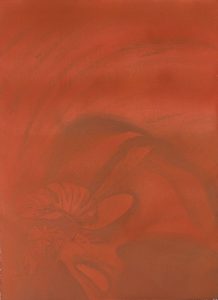
Watercolor & Archival Ink on 100% cotton paper
21.5 x 29.5 Inches
Which artists have inspired you along the way?
Arooj: Watercolor was my first medium, introduced in grade 9 or 10 during art classes when I bought my first set of paints. In college, I used watercolors to render jewelry designs. About two and a half years ago, a friend urged me to revisit watercolors after a decade of experimenting with resin, acrylics, and pouring techniques. That rekindled my connection. Two artists have been particularly inspiring: Janet Pulcho, a Ukrainian botanical watercolorist known for her large-scale, detailed paintings, and Polina Bright, whose conceptual, feminine, and empowering watercolor work carries powerful messages. Their ability to push the medium’s boundaries, from intricate botanicals to bold concepts, inspired me to embrace watercolors fully, reconnecting with a medium that feels like home and elevating my artistic practice.
Can you describe the theme of your show and its personal significance?
Arooj: The show is called “Forge” and it stems from the artist residency “Collective55” managed by the renowned artist and curator Qasim Bugti. It is centered on transformation, reconstruction, and rebuilding. At the time, I was creatively stuck, but the residency helped me resolve and transform my painting process. I explored watercolors on larger scales, overcame fear, and reshaped my approach. For me, Forge was about finding beauty in fractured elements through reconstruction. My work addresses the growing distance between humans and nature, human intervention in ecosystems, and the destruction of natural spaces. By painting leaves and feathers, I seek to reconnect with nature’s essence. Previously, my work was directly botanical, painting leaves in a literal way, but currently it’s more abstract, reflecting a personal shift in how I see the world and a broader cultural dialogue about our relationship with art and the environment. This transformation mirrors my evolution as an artist, making the theme deeply significant to my creative journey.
Is there a piece that stands out to you, and are there historical or cultural influences in it?
Arooj: My favorite piece is called “Fossil of a Moment,” featuring a silhouette of a leaf and feather with textured layers. It captures something disappearing yet emerging, like waves flowing to and from the shore, evoking loss and renewal. I connect it to the advancement of technology, like AI, which pulls us away from our natural roots. In the future, ecosystems might feel alien, like fossils—small remnants of a larger landscape. The painting’s shifting topography and map-like quality reflect this disconnection. As an abstract work, it invites varied interpretations, allowing viewers to sense a longing for nature while preserving personal memories. Growing up, I spent hours in my home’s large lawn, surrounded by plants and frequently visited Model Town Park, the memories of which still echo in my imagination. These spaces inspired my collection, serving as a way to preserve those experiences. I worry that younger generations, glued to indoor activities, may never know this connection to nature. My work aims to capture that fading experience, bridging past and present for viewers who see it.
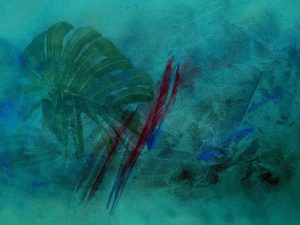
Watercolor on 100% cotton paper
Size 21.5 x 29.5 Inches
For young artists, is watercolor a commercially viable niche?
Arooj: Watercolors are often viewed as less serious than oils or acrylics, tied to traditional imagery. However, in contemporary art, the idea overshadows the medium. While technique remains important, the concept and how it’s presented take precedence. Watercolors can convey powerful ideas, and the art industry is evolving to embrace diverse mediums. Young artists shouldn’t feel restricted by medium—whether watercolor, acrylic, or something unconventional. The key is to focus on the idea and how it resonates with audiences, as this opens up commercial opportunities in today’s art market, where innovation and authenticity are increasingly valued.
How do you balance mass consumption with cultural sensibilities? Do you censor your work?
Arooj: I don’t censor my expression for acceptability, but I create with care and clarity. As a practicing Muslim, I respect boundaries set by my faith, which provide a sense of order. These limitations don’t stifle creativity, they actively fuel it. When you can’t do something one way, you find another, pushing you to explore new approaches. For example, working within these boundaries has led me to innovative ways of conveying ideas, making limitations an opportunity for creative growth. This balance allows me to stay true to my voice while respecting cultural and personal values, ensuring my work communicates meaningfully to various types of people with different beliefs.
How do you choose galleries that align with your personal style?
Arooj: It’s crucial to research galleries that embrace experimentation and conceptual art. Some galleries cater to modern art buyers, while others serve clients who prefer traditional landscapes or still- lifes. Study a gallery’s focus and clientele to ensure it aligns with your work. A gallery that shares your artistic vision will better connect your art with the right audience, amplifying its impact and ensuring it’s appreciated by those who value your creative approach.
For your Muse Gallery show, is there a natural sequence to the paintings? Did you plan the progression or let it emerge organically?
Arooj: The sequence emerged organically. Each painting inspired the next, with ideas flowing naturally as I worked. It was a process of discovery, translating what I envisioned onto the canvas without a rigid plan. This intuitive approach allowed the collection to evolve authentically, reflecting the creative journey sparked by the residency and my evolving perspective on nature and transformation.
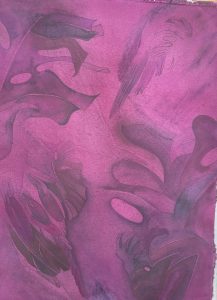
Watercolor & Archival Ink on 100% cotton paper
21.5×29.5 Inches
Why just allude to nature’s biorhythms in the context of climate change rather than a literal depiction?
Arooj: Subtlety is more effective than preaching facts. Art should evoke calm, not anxiety about the destruction we already face. My pieces convey the loss of connection to nature and fading memories of its presence, but they also offer hope, suggesting we can reconnect. Literal depictions of doom can be a bit too on the nose, and induce a sense of danger and despair. I want viewers to feel soothed, not overwhelmed, and to arrive at their own interpretations without feeling instructed. This approach aligns with my belief that art should inspire reflection, not dictate conclusions, especially on urgent issues like climate change, allowing viewers to engage with the message on their own terms.
How important is the drying process in your watercolor work, given its impact on meaning through pooling and deepening colors?
Arooj: The drying process is critical, though I control about 80% of it. The wetting and drying stages depend on temperature and paper moisture, affecting how paint layers and settles. While wet, a painting may look perfect, but drying can alter opacity or introduce unexpected strokes. Each piece is an experiment due to watercolors’ unpredictability. I often stand by, watching it dry, embracing the outcome as part of the medium’s charm. This process shapes the depth and texture that give my work its emotional resonance, enhancing the narrative of transformation and nature.
How do you want the audience to perceive your pieces, and how does the gallery experience support that? Are you aiming for environmental consciousness?
Arooj: I hope viewers leave with a softened awareness of nature’s importance, delivered through a subtle, calming message. My soothing color palette—bright but not loud—enhances this effect. The gallery’s credibility elevates my work, attracting a serious audience and creating an ambiance that amplifies the message. Unlike displaying at home, a professional space ensures the right audience engages meaningfully with my art. While I aim to foster appreciation for nature, the goal is to inspire reflection rather than preach environmental consciousness, allowing viewers to connect personally with the work and find their own meaning.
Bio Note: Arooj Shahid is a contemporary visual artist based in Lahore. She earned her bachelor’s degree in Jewellery Design from Pakistan Institute of Fashion and Design (PIFD).Though largely self- taught in painting, she refined her artistic practice under established artists, developing an intuitive approach to creative expression across multiple mediums.