
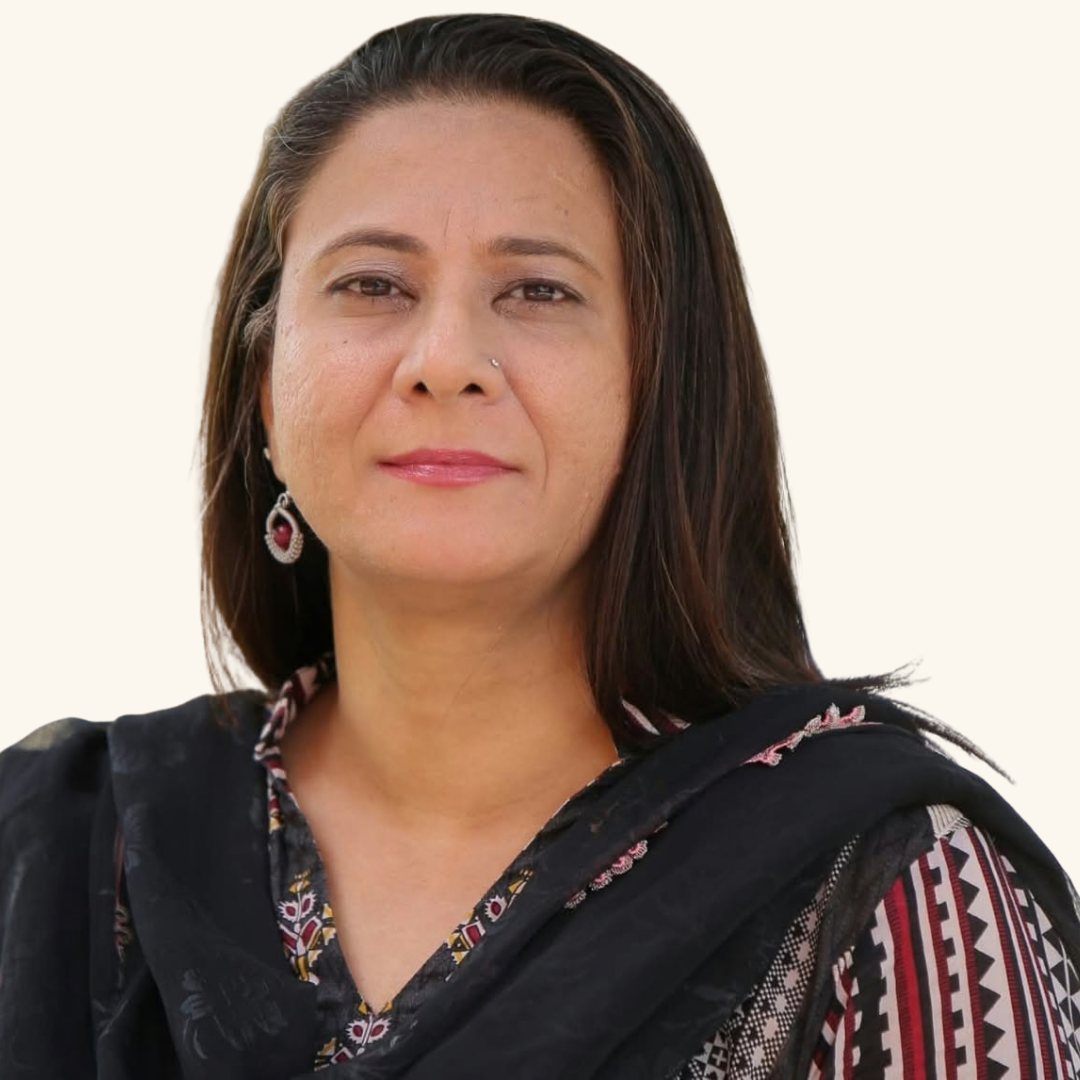
Dr. Nukhbah Taj Langah has spent much of her academic life crossing linguistic borders. Trained in English literature at the University of Buckingham (UK) before completing an MA from the University of Warwick and a PhD from the University of Leeds in the UK, she has built a body of work that conducts interdisciplinary research focused on postcolonial studies, translation, resistance literature, and Siraiki cultural history. Her books include a monograph, Poetry as Resistance: Islam and Ethnicity in Postcolonial Pakistan (2020), several co-edited volumes including: Film, Media and Representation in Postcolonial South Asia (2021) and Literary and non-Literary Responses towards 9/11: South Asia and Beyond. Recently she has contributed two more co-edited volumes including: Narratives of Loss and Longing: Literary Developments in Postcolonial South Asia (2025) and Nation and Nationalism in South Asian Literature (2026). Alongside these, she has continued to publish on Siraiki language and identity, most recently in articles such as “Siraiki Language Speakers in London: A Case Study” (2024) and “Siraiki Trīmtī (Feminism): An Autoethnographic Account” (2026).
When the RBTL team spoke with her on Zoom, Dr. Langah was temporarily associated with the Department of English at the Universiti Malaya after fourteen years of affiliation with Forman Christian College in Lahore. Our conversation began with a focus on her diverse academic experiences that later eventually weaved into questions of language and translation, particularly with regards to Siraiki. She repeatedly returned to the same idea: that different languages symbolize different mindsets, and that preserving a language also means preserving the histories, metaphors, and ways of thinking that might otherwise deteriorate, if not altogether disappear, from popular consciousness of the communities.
Interviewer: You’ve recently moved to Universiti Malaya. How has the transition been?
Dr. Langah: I’m settling in well, thank you. Southeast Asia was never really on my agenda. I had planned to take a sabbatical from Forman Christian College and spend a year elsewhere as a visiting faculty. I wanted a different academic environment, a chance to experience another university and educational system and take a break from my routine. However, this experience became more dynamic than what I expected. Every move in my academic life has changed the direction of my work. I don’t think any of it was planned. One opportunity simply led to another and, therefore, my current stint at Universiti Malaya is very different to my prior experiences in the UK and Europe.
Interviewer: You completed your PhD in England, returned to teach in Pakistan, and are now working in Malaysia. How has moving between these different linguistic worlds shaped you as a researcher and translator?
Dr. Langah: England belongs to a very important phase of my life. I first went there as an undergraduate English Literature student, and it was during my MA in Colonial and Postcolonial Literature at the University of Warwick that my research interests changed. I became increasingly drawn towards questions of language, identity, and South Asia.
When I started my PhD at the University of Leeds, my proposal was actually about Partition literature. Siraiki literature appeared only as one chapter. During my very first meeting, my PhD supervisor (Professor Ananya Jahanara Kabir) asked if we could walk into Leeds city centre because she had to visit an office and didn’t have another free slot that day. We spoke while walking, and those twenty to twenty-five minutes ended up completely transforming the direction of my research. She told me very frankly that she wasn’t interested in my PhD proposal focused on Partition literature.
She explained the reasons too. Surprisingly enough, she had already looked into my family background and knew about my connection with the Siraiki region and the political activism that my father had launched within this region. She said that there were already many scholars working on Partition, and I had something they didn’t. I represented the Siraiki culture and language. As an insider, I had free access to the community which gave me the privilege to work on Siraiki cultural and literary history. This is when I decided to work on contemporary Siraiki poetry as it vigorously represented Siraiki language and culture. I thought working on poetry was the difficult part because my supervisor said that if I was indeed going to work on contemporary poetry, I must translate it myself. I remember thinking how I could even do that. The prospect was frightening, I was a keen researcher, but definitely not a translator. I didn’t think of myself that way. But this idea also initiated my journey towards becoming a translator. Like many Siraiki speakers, I had grown up speaking my mother language at home. Reading and writing literary Siraiki was another matter altogether. I even asked Professor Kabir whether somebody else could do the translations while I concentrated on the analysis. She refused and said the translation had to be authentically my own because this would contribute to my research. Whether it turned out well or badly, I had to work through the language on my own.
Besides experiencing the challenges of living abroad, translation became the most intellectually demanding part of my PhD experience. I consulted a lot of dictionaries, I interviewed poets to ask what particular words meant, why they had chosen one metaphor instead of another, or whether an image carried a cultural meaning that someone outside the region would miss. Even though Siraiki is my mother tongue, I realised there were many literary expressions I had never encountered. I grew up in Lahore, studied in English-medium schools, and my daily life was shaped by Urdu, English and Punjabi while my parents and close family spoke Siraiki which I learned at home. Literary Siraiki was definitely another world.
That experience also made me appreciate translators much more than I had before. When people read a translation, they often think the translator has simply replaced one word with another. The work is much more complicated than that. You are constantly making decisions, you ask yourself whether to preserve the original metaphor, image, whether an English reader will understand it, whether a footnote is necessary, whether changing one word alters the emotional tone of the poem. Somehow, I crossed these barriers.
While finishing my PhD, I had the opportunity to work with the Poetry Translation Centre in London. We translated the Urdu poetry of Noshi Gilani with a British translator. Later on we worked on translating Siraiki poets, we would workshop poems and translations, but the challenge was that it was primarily a non-Siraiki and Western audience. I translated Siraiki poetry by Riffat Abbas, Shakir Shujabadi and Ahmed Tariq for PTC in the same collaborative way by joining their workshops. Working with a native English poet was another education. Sometimes I would insist that a particular word had to remain because it carried a cultural meaning, but my collaborator would say no, we are translating for the English reader who cannot relate to it the same way. And we would again spend time on revising and editing the translation.
Translating collaboratively and such considerations made me realise that when you are translating you are also negotiating with the other language. You try to remain faithful to the original while allowing the new reader to experience something of the same feeling. This is how I got deeper and deeper into translation. I would love to keep doing it more and more but now research work takes up most of my time.
Interviewer: How has your experience of living and working in Malaysia compared with your years in Pakistan and England?
Dr. Langah: Malaysia has been fascinating because the Malay language occupies such an important place in the public, cultural and social life of the local communities. Malaysia is a very nationalist country. Though English is widely spoken in institutions and Chinese, Tamil and Hindi are also spoken as a national language, Malay/ Bhasha Melayu is prioritised; administrative work, official communication, meetings, everything returns to the national language.
As someone who has spent years thinking about language politics in South Asia and has also spent a lot of time in an English speaking country (Britain), I found this dynamic very interesting. Living here has also crystallised the reality for me that if you don’t speak a people’s language, there is always a part of their culture that is beyond your access. It’s a different mindset. I can’t understand the culture fully, even if I can communicate effectively in English in Malaysia because I don’t speak and barely understand Malay.
I can manage everyday life. Technology makes that much easier now. I’ve arranged appointments through Google Translate, I’ve even communicated with technicians who spoke only Malay or Indonesian. Once I translated my messages into Malay, and the replies came back in Indonesian voice notes. But even then, we somehow managed to understand each other well enough for the person to come and get on with repairs in my apartment.
One thing I have noticed is that language changes the way you experience a place. Language is also a mindset. In Pakistan, I have never really felt isolated because there is usually another language that creates a bridge. Even in different provinces of Pakistan, communication has been possible for me as people can switch between Urdu, Siraiki, Punjabi and English. Even when I have visited remote areas of Pakistan I have never had the experience of being completely languageless.
Malaysia has been different. Kuala Lumpur is a metropole, so competency in spoken English is often enough. Outside the larger cities, that changes very quickly. Ironically, I have become more cautious about travelling alone here than I ever was even in Europe. Europe gave me confidence that eventually somebody nearby would speak English. Here I sometimes think what would happen if I landed somewhere and simply can’t explain what I need? And it has nothing to do with safety since in general Malaysians are very respectful and extremely kind people. However, I am now aware of what happens when we face barriers due to language differences. Drawing from my own experiences in various countries, I strongly believe that language shapes the way people see the world.
Interviewer: Is communicating across languages more difficult abroad, or back in Pakistan, where Siraiki itself remains marginalized?
Dr. Langah: This is interesting because the challenges are different. In Pakistan, I have always been conscious of the position of the Siraiki language and community. It is my mother tongue, but as indicated earlier, like many people of my generation, I was educated almost entirely through English and Urdu. I grew up speaking Siraiki at home, yet you don’t necessarily learn to read or write it in a formal way. When I began working seriously with Siraiki literature, I realised there were many words, idioms and literary expressions I had not encountered in learning the spoken Siraiki language communication. So even within your own language, there is a process of rediscovery primarily if you cannot formally learn your mother language.
Living in Malaysia has made me appreciate the importance of language even more. When you become an outsider, you understand how much language determines your confidence. Something as ordinary as going to a government office, filling official forms, asking for directions or explaining a problem becomes much more complicated when you don’t speak the local language. I think that’s also why I have become even more convinced that language is never only about communication. There are histories and memories embedded in a language mindset that only native speakers have access to.
Interviewer: Your work on Siraiki has made you one of its most visible advocates, a torchbearer of sorts. Was that something you always intended?
Dr. Langah: I am honored that you think of me this way, but no. If anything, I thought somebody else would do it. My father devoted his entire life to the Siraiki political movement and activism. For many years he believed I would never follow him. He thought I had been influenced by my upbringing in Lahore (read as Punjab), and later on became too westernised after studying abroad. And that I had other interests, so I don’t blame him for thinking that. My education was in English literature, and later I had worked on postcolonial studies. Nothing suggested that I would eventually spend so much of my career working on Siraiki. I always admired what my father was doing, but I used to underestimate my own contribution to his cause. Part of this credit goes to Professor Kabir’s initial pep talk during our walk to Leeds city centre where she made me conscious of what I can contribute to my community as a Siraiki native speaker and as someone who was raised by parents who were Siraiki activists.
I often tell people that I have a habit of doing that, underestimating myself I mean. At one point my father had wanted me to study law, as he himself had been a barrister, but I convinced myself I wasn’t capable of becoming a lawyer, I couldn’t picture myself arguing in the courts all day. Funnily enough, now I do the same in academic research papers. My journey and initial thoughts toward translation were similar. When my supervisor insisted that I translate Siraiki poetry, my immediate response was that I couldn’t do it.
After my father passed away, people from the Siraiki community began approaching me. They would say, “now carrying forward his cause and vision is your responsibility.” And initially I resisted that idea. I was grieving. I thought perhaps I could help for a while until things settled down after his demise, but I never imagined taking over the work in any permanent sense. Only gradually that changed and the more I engaged with the Siraiki community, attended literary gatherings and immersed myself through research and activism, the more I realised I couldn’t separate my academic work from the community I belonged to. Looking back, I don’t think I chose this path consciously. Now it feels like this was destiny’s plan.
Interviewer: Has your advocacy for Siraiki language and literature affected how people in Pakistan or abroad have viewed you?
Dr. Langah: Yes, and sometimes in unexpected ways. Initially, before departing for studies in the UK, I had appeared in the entry test for the National College of Arts (perhaps around 1993). I cleared the art and English test but was rejected by the interview panel because someone asked me why would I waste a seat of a dedicated art student when I may later join politics. This was a shocking rejection but a blessing in disguise because this motivated me to actively pursue my undergraduate admission in the UK which was always my parents incentive.
Later, this happened again when I returned to Pakistan after completing my PhD. I was interviewed at a well established privileged university where, instead of discussing my research, the interview panel questioned the authenticity of Siraiki history and the validity of my research. They told me that there was no separate Siraiki language or history, that the real history was Punjabi, and that the case my father and I had argued for decades had no academic basis. I had just completed a doctorate in England. I expected to discuss my research methodology, my arguments and my publications. Instead I found myself defending the legitimacy of my research and cause before these conversations even began.
I remember leaving that interview thinking I could never work at a place where my research was dismissed before anyone had actually engaged with it. Ironically, I also encountered a different kind of scepticism within Siraiki circles. Some people assumed I would never become involved in Siraiki neonationalism because of my western education. Others expected me to become exactly like my father. It was traumatizing in a way. But over the years I have stopped worrying about whether people accepted me or not. Academic work requires patience. You continue writing, publishing and teaching. Eventually people begin reading the work instead of relying on assumptions. Similarly, activism demands dedication to the cause, which I try to do to the best of my ability despite my professional engagements.
This has been one of the most satisfying changes and challenges in the journey. Today many people know my research before they know me personally, but it took a long time and a lot of effort to get to this position.
Interviewer: Have there been moments when you felt misunderstood?
Dr. Langah: Most people consider my political identity before they review my scholarship. They know my family background and involvement in Siraiki activism. They know my father was associated with the Siraiki movement. They know I work on Siraiki literature. All of this creates an impression before they even read my work. And of course, being a woman brings its own challenges both in academia and Pakistani culture. Having said that, I don’t think gender was the defining struggle in my own career and activism. My linguistic and political identity usually overshadowed everything else.
Interviewer: Your work began with Siraiki literature but has gradually expanded into broader questions of postcolonialism, archives and the Global South. How do those different strands come together?
Dr. Langah: For me, they were never really separate. People sometimes think I have moved away from Siraiki because I have worked on subjects like 9/11, media, cinema or feminist discourses but I don’t see it that way. Throughout all of those projects I have consistently worked on Siraiki because I feel there is still so much that needs to be done. I feel that as an academic it’s still one of my life’s goals to empower Siraiki. When I began presenting my research internationally, I realised that outside Pakistan, very few people knew what Siraiki was. They would ask what is the history of Siraiki language and culture, which meant I had to explain them from scratch. Within Pakistan there is already a substantial body of scholarship on Siraiki language, literature and identity. But even then there is no state support for establishing Siraiki language or preserving Siraiki cultural heritage. There is the Lahorization and Punjabization of culture to suppress Siraiki culture and identity. Before anyone can appreciate the literature, they first have to understand the existence and history of the language itself.
Questions of language, power and representation are not unique to Siraiki. Many communities across the Global South have experienced similar histories. Their languages have been pushed aside, their literary traditions overlooked, and their histories written by others. I realised there was value in bringing Siraiki into those conversations globally instead of discussing it only within the boundaries of Pakistan.
One project that grew directly from this vision was a UCLA-funded archive project, “Archives of Siraiki Cultural and Political History in Pakistan” that I recently had the opportunity to work on, and it was actually hosted at Universiti Malaya. In that project, we looked at private libraries that had decades of books, journals, newspapers, letters and pamphlets related to the Siraiki movement. These were personal libraries created by individuals who cared about preserving their history. As I said earlier too, there is no government support for this type of work, these are not institutional archives. It is the Siraiki people who have taken up this massive literary and intellectual work of documenting these collections and preserving cultural heritage. Some belonged to writers, others to researchers or activists. Many contained material that would be very difficult to find anywhere else including my father’s own political documentation. My long-term goal is to digitise them and make them available to researchers globally .
During this project, one of the challenges that our research team faced was that some library owners were hesitant about their collections being digitized. They asked, “If everything becomes available online, why would anyone visit us?” I understood that concern because these collections represent a lifetime of work and also attracts readers, researchers and activists to these remote locations where they are physically preserved. At the same time, I believe that they will have limited life if they are not digitally preserved and knowledge thrives by becoming broadly or globally accessible. So it’s a difficult question. We know writers from Africa, Latin America and other parts of the world because their work travelled beyond their original communities. Readers discovered them because translations were produced, archives were built and books became available internationally. And I would like to see Siraiki literature receive the same opportunity.
As an individual can’t change institutions overnight, my strategy is to continue writing about Siraiki language, culture and history. I can document literary history, preserve archives and introduce Siraiki scholarship to readers who might otherwise never encounter it. Even in the worst case scenario if I leave behind twenty publications, they will still be a contribution long after I am gone. Someone else may build on them. This is a really important goal for me.
Interviewer: Will translation continue to remain an important part of your work?
Dr. Langah: Research has occupied much more of my time in recent years, so I haven’t translated as much as I did during my PhD or while working with the Poetry Translation Centre. Even so, translation remains one of the most satisfying things I have ever done. If the opportunity comes again, I would happily return to translation because I still enjoy that process of discovering what languages reveal about one another.
My own monograph Poetry as Resistance: Islam and Ethnicity (2012) has been translated by my student (Akhtar Mirza) into Urdu and in Sindhi by Dr. Badar Ujan. I am in the process of getting these translations published to make the work available to a broader readership. I am also completing an edited book with Akhtar Mirza which is focused on Translation and Praxis in Pakistan: An Orientation (forthcoming) where we discuss the theoretical and practical challenges faced by translation theorists and translators in Pakistan.
Interviewer: What advice would you give younger translators working in the age of AI?
Dr.Langah: Perhaps I am old-fashioned, but I still believe translation begins with one’s love for language, and only people who are really passionate about it get into translating other languages and work. Nobody becomes a literary translator because it’s the easiest profession. You do it because you enjoy the long and arduous process.
Artificial intelligence can certainly be useful. If I am looking for the meaning of a word or trying to remember a particular expression, I don’t see any problem in using technology as a tool. But I do believe that translating a page with one click won’t be the same translation as a human translator were to do it. AI has no emotions or “mind”, so to speak, it won’t feel the emotions conveyed through a text like a human does. As I said earlier, translators are or should be fully involved with the cultural context and language of the text which they are translating, their emotions and their mind are fully involved in this process.
I believe there will always be room for human translators because readers are looking for more than accuracy. They are looking for sensitivity towards a language and cultural nuances and imagination of the translator in translating them. And these are purely human qualities, I don’t think AI can aptly perform this task.
Interviewer: Thank you Dr. Nukhbah for the most illuminating discussion, we learnt a lot.
Dr. Langah: Thank you for conducting this interview.